
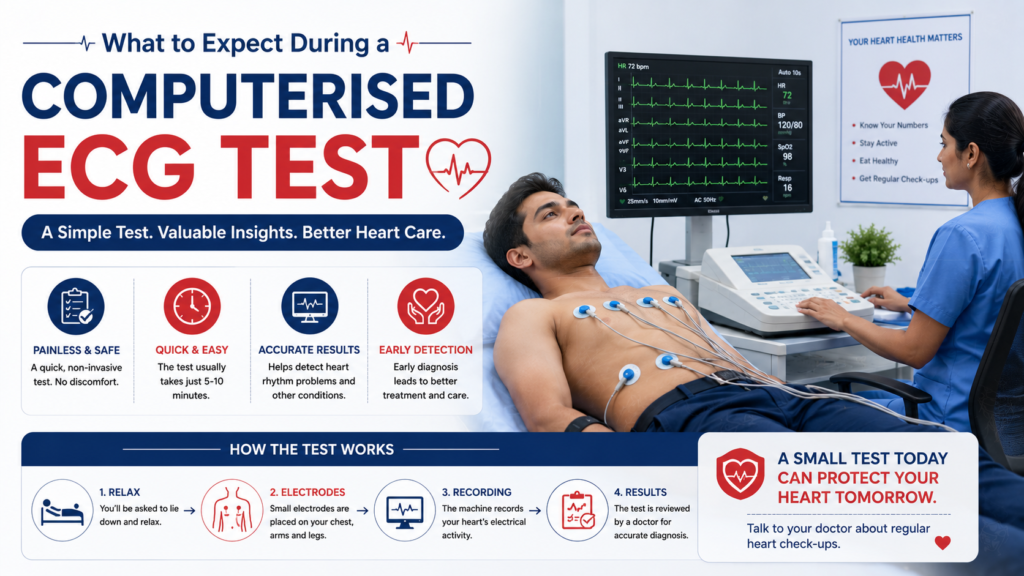
Computerised ECG Test is a quick, painless, and reliable diagnostic procedure that helps doctors evaluate your heart’s electrical activity and identify potential heart-related conditions early.
Your heart beats thousands of times each day, pumping oxygen-rich blood throughout your body. While most people think about heart health only when symptoms appear, many heart conditions can develop silently. A Computerised ECG Test is one of the simplest and most commonly used diagnostic tools to assess how your heart is functioning.
Whether you’re visiting a hospital for chest pain, palpitations, dizziness, or as part of a routine health check-up, your doctor may recommend this test. Understanding what happens during the procedure can help you feel more comfortable and prepared.
What Is a Computerised ECG Test?
A Computerised ECG Test records the electrical signals produced by your heart with every heartbeat. Small adhesive electrodes are placed on your chest, arms, and legs to capture these signals.
The information is displayed as waveforms on a computer, allowing healthcare professionals to evaluate your heart rhythm, heart rate, and electrical activity. The computerized system also provides a preliminary interpretation, which is then reviewed and confirmed by a qualified doctor.
Unlike imaging tests, an ECG does not show the structure of the heart. Instead, it measures how the heart’s electrical system is working.
Why Might Your Doctor Recommend This Test?
Doctors may advise a Computerised ECG Test for many different reasons. It can help investigate symptoms, monitor existing heart conditions, or serve as part of a preventive health assessment.
Common reasons include:
- Chest pain or discomfort
- Irregular heartbeat or palpitations
- Shortness of breath
- Dizziness or fainting
- High blood pressure
- Routine health screening
- Before certain surgeries
- Monitoring heart medications
The test provides valuable information that may help your doctor decide whether additional evaluation is needed.
How Should You Prepare?
One of the advantages of a Computerised ECG Test is that very little preparation is required.
Before your appointment:
- Wear comfortable clothing.
- Avoid applying body lotions or oils on your chest.
- Inform your doctor about any medications you take.
- Remove necklaces or metallic accessories if requested.
- Stay relaxed before the test.
In most cases, you can eat and drink normally unless your doctor gives different instructions.
What Happens During the Procedure?
A Computerised ECG Test usually takes only a few minutes.
During the examination:
- You’ll lie comfortably on an examination table.
- The technician will clean small areas of your skin if necessary.
- Adhesive electrodes will be attached to your chest, wrists, and ankles.
- Thin wires connect the electrodes to the ECG machine.
- You’ll be asked to remain still and breathe normally while the recording is taken.
The machine records your heart’s electrical activity within seconds.
The procedure is completely painless, and the electrodes only detect electrical signals—they do not send electricity into your body.
What Information Does the ECG Provide?
A Computerised ECG Test helps doctors evaluate several aspects of heart function, including:
- Heart rate
- Heart rhythm
- Electrical conduction
- Signs of previous heart injury
- Certain rhythm abnormalities
- Evidence that may suggest reduced blood flow to the heart
Although the computerized system generates an initial analysis, the final interpretation is always made by a qualified healthcare professional who considers your symptoms and medical history.
Is the Test Safe?
Yes. A Computerised ECG Test is considered a very safe, non-invasive procedure.
There are:
- No injections
- No radiation
- No electric shocks
- No needles
- No recovery time
After the test, you can usually return to your normal daily activities immediately.
Some people may notice mild skin irritation after electrode removal, but this usually settles quickly.
What Happens After the Test?
Once the recording is complete, the electrodes are removed, and your report is reviewed.
Depending on the findings, your doctor may:
- Explain that the ECG appears normal.
- Recommend additional heart tests if needed.
- Prescribe medication when appropriate.
- Refer you to a cardiologist.
- Suggest lifestyle changes to improve heart health.
A normal ECG does not always rule out every heart condition. If symptoms continue, your doctor may recommend tests such as an echocardiogram, Holter monitoring, stress testing, or other cardiac investigations.
When Should You Seek Medical Attention?
While a Computerised ECG Test is an important diagnostic tool, never ignore symptoms such as:
- Severe chest pain
- Sudden shortness of breath
- Fainting
- Persistent palpitations
- Heavy sweating with chest discomfort
- Pain spreading to the jaw, shoulder, or left arm
These symptoms require immediate medical evaluation and should not be delayed while waiting for routine testing.
Final Thoughts
A Computerised ECG Test is one of the fastest and most effective ways to assess your heart’s electrical activity. It is painless, safe, and provides valuable information that helps doctors diagnose or monitor many heart-related conditions.
Whether performed as part of a routine health check-up or to investigate symptoms, the test plays an important role in supporting timely diagnosis and treatment.
If your doctor recommends a Computerised ECG Test, there is no need to worry. The procedure is simple, takes only a few minutes, and can provide essential information about your heart health.