
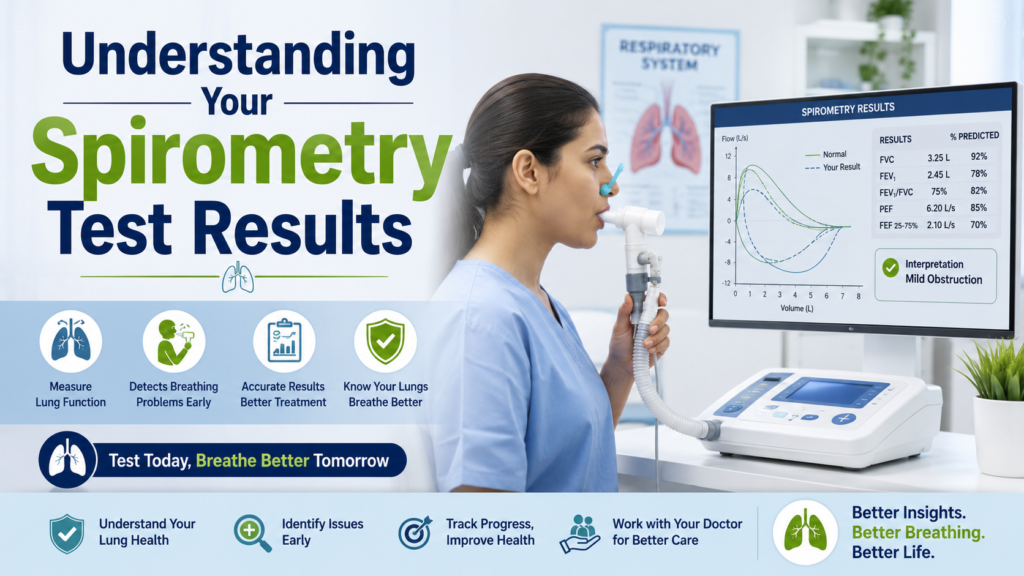
Spirometry Test Results can help doctors understand how well your lungs are working, identify breathing problems, and guide the right diagnosis and treatment.
Breathing is something we often take for granted until it becomes difficult. If you have been experiencing persistent cough, wheezing, shortness of breath, chest tightness, or reduced exercise tolerance, your doctor may recommend a spirometry test to evaluate how well your lungs are functioning.
Spirometry is a common and non-invasive lung function test. It measures how much air you can breathe out and how quickly you can force air from your lungs. The test is often used to evaluate conditions such as asthma, chronic obstructive pulmonary disease (COPD), and other breathing disorders.
For many patients, looking at a spirometry report for the first time can feel confusing. Numbers such as FEV1, FVC, and FEV1/FVC ratio may seem difficult to understand without medical guidance.
The good news is that understanding the basic terms can make your report easier to follow.
Let’s take a closer look at what these measurements mean and how doctors interpret them.
What Is Spirometry?
Before understanding the numbers, it helps to know what happens during a spirometry test.
During the test, you will usually sit comfortably and breathe through a mouthpiece connected to a device called a spirometer. A healthcare professional will guide you through the process.
You may be asked to:
- Take a deep breath
- Seal your lips around the mouthpiece
- Blow out as hard and as fast as possible
- Continue exhaling for several seconds
- Repeat the test a few times
The test may be repeated to make sure the results are consistent. In some cases, your doctor may perform the test before and after giving you a bronchodilator medication. This helps determine whether your airflow improves with the medicine.
Your effort during the test matters. If you do not inhale deeply enough or do not blow out forcefully enough, the results may not accurately reflect your lung function.
This is why a trained professional carefully monitors the test and checks whether the measurements are reliable.
The Two Main Measurements: FEV1 and FVC
Two of the most important numbers in Spirometry Test Results are FEV1 and FVC.
FEV1
FEV1 stands for Forced Expiratory Volume in the first second.
It measures how much air you can forcefully breathe out during the first second of a strong exhalation after taking a deep breath.
A reduced FEV1 may suggest that air is having difficulty moving out of the lungs. This can happen in conditions that cause airway narrowing or obstruction.
FVC
FVC stands for Forced Vital Capacity.
It refers to the total amount of air you can forcefully breathe out after taking the deepest breath possible.
FVC gives doctors information about the overall amount of air that can be exhaled during the test.
Looking at FEV1 and FVC together provides more useful information than considering either number alone.
What Does the FEV1/FVC Ratio Mean?
The FEV1/FVC ratio is another important part of Spirometry Test Results.
It compares the amount of air exhaled during the first second with the total amount of air exhaled during the entire forced breath.
In simple terms, it helps doctors understand how quickly air is leaving your lungs.
A lower-than-expected ratio may suggest an obstructive pattern, meaning there may be difficulty getting air out of the lungs because of narrowed or blocked airways.
Conditions such as asthma and COPD can cause an obstructive pattern.
However, the interpretation is not based on the ratio alone. Your doctor will consider your age, height, sex, symptoms, medical history, and the reference values used by the laboratory.
What Are Predicted Values?
When you look at your report, you may notice several columns showing terms such as:
- Measured value
- Predicted value
- Percentage predicted
- Lower limit of normal
The predicted value is an estimate of what would generally be expected for someone with similar characteristics, such as age, height, and sex.
Your actual measurement is compared with the predicted value to help determine whether your lung function is within the expected range.
However, predicted values are not the same for everyone. Modern interpretation also considers the lower limit of normal (LLN) and, where appropriate, z-scores rather than relying only on a fixed percentage.
This is important because a result that appears “normal” based on a simple percentage may not always be normal for a particular person.
Your healthcare professional will interpret the results using appropriate reference standards.
What Does a Normal Spirometry Pattern Look Like?
A normal spirometry pattern generally means that the amount of air you can forcefully exhale and the speed at which you can exhale are within the expected range for you.
If your FEV1, FVC, and FEV1/FVC ratio are within the expected limits, your doctor may consider the test consistent with normal lung function.
However, a normal spirometry test does not necessarily rule out every possible breathing problem.
Some conditions may not be detected by basic spirometry alone. For example, symptoms caused by certain airway disorders may require additional testing.
If you continue to experience symptoms despite normal spirometry, your doctor may recommend further evaluation based on your individual situation.
What Does an Obstructive Pattern Mean?
An obstructive pattern occurs when it becomes more difficult to move air out of the lungs quickly.
This may be reflected by a lower FEV1/FVC ratio.
Common conditions associated with airflow obstruction include:
- Asthma
- COPD
- Chronic bronchitis
- Emphysema
- Certain other airway disorders
The severity of obstruction can vary.
In asthma, airflow limitation may improve significantly after using a bronchodilator. In COPD, airflow limitation is generally more persistent.
However, spirometry alone does not always tell the complete story. Your symptoms, medical history, physical examination, and other tests may all be important in reaching a diagnosis.
What Does a Restrictive Pattern Mean?
A restrictive pattern suggests that the total amount of air your lungs can hold may be reduced.
On spirometry, this may appear as a reduced FVC with a preserved or relatively high FEV1/FVC ratio.
However, spirometry by itself cannot always confirm true restriction.
A low FVC may occur for several reasons, including incomplete exhalation, poor test effort, air trapping, or a genuine reduction in lung volume.
To confirm a restrictive lung pattern, your doctor may recommend additional pulmonary function tests, particularly measurement of total lung capacity (TLC).
Possible causes of true restriction can include certain lung diseases, chest wall conditions, neuromuscular disorders, or other medical conditions.
This is why a single number should never be interpreted in isolation.
What Is a Mixed Pattern?
Sometimes, a person’s lung function may show features that suggest both obstruction and restriction.
This is sometimes described as a mixed ventilatory pattern.
However, spirometry findings alone may not always confirm that both conditions are genuinely present.
Further testing, such as complete pulmonary function testing and measurement of lung volumes, may be needed to understand the underlying problem.
Your doctor may also consider imaging studies, medical history, and other clinical information.
The important point is that a spirometry report provides valuable information, but it is only one part of the overall diagnostic process.
What Does a Bronchodilator Response Tell You?
In some cases, spirometry is performed before and after using a bronchodilator medication.
A bronchodilator is a medicine that helps relax and open the airways.
If lung function improves after the medication, it may indicate that the airways are responsive to bronchodilator treatment.
This type of response can be helpful when evaluating conditions such as asthma.
However, the absence of a significant response during one test does not automatically rule out asthma. Symptoms can vary over time, and asthma may require additional testing depending on the clinical situation.
Your doctor will interpret the results alongside your symptoms and medical history.
Why Your Test Effort Matters
One of the most important things to understand about Spirometry Test Results is that the quality of the test can affect the interpretation.
Spirometry requires active participation. You need to inhale deeply and exhale forcefully and continuously according to the instructions provided by the healthcare professional.
Factors that may affect test quality include:
- Not taking a full breath before exhaling
- Stopping the exhalation too early
- Coughing during the test
- Poor mouth seal around the mouthpiece
- Hesitating before blowing
- Not following instructions correctly
If the test quality is poor, the numbers may not accurately represent your true lung function.
A good-quality test usually includes repeated efforts that are sufficiently consistent.
If your doctor feels the test was not reliable, you may be asked to repeat it.
Can Spirometry Diagnose Asthma?
Spirometry can be an important tool when evaluating asthma, but diagnosing asthma is not always as simple as looking at one test result.
Asthma symptoms often vary over time. A person may have normal lung function on the day of testing and still have asthma.
Depending on your symptoms and medical history, your doctor may recommend:
- Repeat spirometry
- Bronchodilator testing
- Peak flow monitoring
- Bronchial provocation testing
- Other lung function tests
Symptoms such as wheezing, cough, chest tightness, and shortness of breath may have several possible causes.
Therefore, a complete medical assessment is important.
Can Spirometry Diagnose COPD?
Spirometry plays a central role in diagnosing COPD.
People with COPD may experience symptoms such as:
- Long-term cough
- Increased mucus production
- Shortness of breath
- Wheezing
- Reduced ability to exercise
A history of smoking or long-term exposure to certain workplace or environmental pollutants may increase the risk.
If your doctor suspects COPD, Spirometry Test Results can provide important information about airflow limitation.
However, the diagnosis should be based on appropriate clinical assessment and spirometric findings rather than symptoms alone.
If you have persistent breathing difficulties, especially if you have a history of smoking or significant exposure to lung irritants, discuss your symptoms with a healthcare professional.
What If Your Results Are Abnormal?
An abnormal spirometry result does not automatically mean that you have a serious lung disease.
There are many possible reasons for an unusual result.
These may include:
- Asthma
- COPD
- Poor test technique
- Inadequate effort
- Recent respiratory infection
- Obesity
- Certain chest wall conditions
- Neuromuscular problems
- Other lung conditions
Your doctor will consider your age, symptoms, medical history, physical examination, and the quality of the test before deciding what the results mean.
Depending on your situation, you may need additional tests such as a chest X-ray, CT scan, full pulmonary function testing, or other investigations.
Try not to worry based only on the numbers printed on your report.
Why One Number Does Not Tell the Whole Story
It is tempting to look at your report and focus on one value that appears high or low.
However, lung function is more complex than a single measurement.
A doctor may look at:
- FEV1
- FVC
- FEV1/FVC ratio
- Predicted values
- Lower limit of normal
- Z-scores
- Flow-volume loops
- Test quality
- Bronchodilator response
The results are then interpreted alongside your symptoms and medical history.
For example, two people with similar FEV1 values may have completely different health conditions depending on their age, symptoms, and other test findings.
This is why it is best to discuss your report with the doctor who ordered the test rather than trying to diagnose yourself from the numbers.
When Should You See a Lung Specialist?
If you have ongoing breathing problems or an abnormal lung function test, your doctor may refer you to a pulmonologist.
You may benefit from specialist evaluation if you experience:
- Persistent shortness of breath
- Frequent wheezing
- Chronic cough
- Repeated chest infections
- Unexplained reduction in exercise tolerance
- Abnormal lung function tests
- Suspected asthma or COPD
- Breathing symptoms that are not improving with treatment
A pulmonologist can perform a more detailed assessment and recommend additional tests when necessary.
Early evaluation can help identify the cause of breathing symptoms and guide appropriate treatment.
Final Thoughts
Understanding Spirometry Test Results can make it easier to participate in your own healthcare and have more informed conversations with your doctor.
FEV1, FVC, and the FEV1/FVC ratio are important measurements, but they should never be viewed in isolation. The quality of the test, predicted values, symptoms, medical history, and other clinical information all contribute to the final interpretation.
If your report shows an abnormal result, try not to panic. An unusual number does not always mean you have a serious condition. Your doctor may recommend repeat testing or additional investigations to understand what is happening.
If you have persistent cough, wheezing, shortness of breath, or other breathing concerns, don’t ignore them. A timely evaluation can help identify the cause and ensure you receive the right care.
Your spirometry report is more than just a set of numbers—it is one piece of information that can help your healthcare team understand how your lungs are working.